
Bed bug heat treatment FAQ Bed bug questions, answered.
Clear, science-based answers on identifying bed bugs, how heat treatment kills them and their eggs, what to expect on treatment day, and keeping them from coming back. Where the science is nuanced, we say so honestly rather than overpromise.
Safety, discretion & who we treat
01Is bed bug heat treatment safe for pets?+
Heat treatment uses no pesticides, so it leaves no chemical residue on floors, bedding or furniture once the space cools. Pets, including fish and their tanks, must be out of the treated area while the treatment runs. We go over pet items with you when you book, and you return once the technician confirms it is safe.
02Is heat treatment safe for my electronics and belongings?+
Most furniture, bedding, clothing and belongings stay in place so the heat can treat them too. A few heat-sensitive items need to come out first. When you book, we go over exactly what applies to your property and answer any questions before treatment day.
03Is your bed bug service discreet?+
Yes. Discretion is part of how Bedbug Seekers works. There is no public-facing signage and no chemical spraying, equipment is staged discreetly, and communication is handled with sensitivity to neighbors, guests and staff. A bed bug problem is personal, so the crew stays professional, low-key and mindful of your privacy from arrival to departure.
04Can you heat treat an apartment unit?+
Yes. An apartment unit can be heat treated when it can be vacated for the treatment period. We work with one designated property contact on the treatment area, access plan and timing, and make sure the resident knows what to expect.
05Do you treat Airbnb and short-term rentals?+
Yes. Whole-room heat suits furnished rentals because it treats mattresses, bed frames and upholstered furniture in place. We help hosts plan around the booking calendar, work with a local property contact for access, and discuss re-entry timing, which depends on completion and cooling. There is no signage and no spraying.
06Do you treat other pests besides bed bugs?+
No. Bedbug Seekers treats bed bugs only, and heat is the only method we use. There is no general pest control, no spraying and no recurring service plan. That single focus means our equipment, training and treatment-day process are all built around how bed bugs actually behave and where they hide.
07What areas of Southern California do you serve?+
Bedbug Seekers serves Southern California, dispatching from Menifee and San Diego. Coverage includes Temecula, Murrieta, Menifee, Riverside, Corona, Hemet, San Bernardino, Lake Elsinore, Perris, Wildomar, Sun City, Canyon Lake, Escondido, San Diego, Los Angeles, Orange, Anaheim, Palm Springs, Victorville and Barstow. Not sure you are in range? Call (866) 551-6552 with your city and property type.
08Do you speak Spanish?+
Yes. Hablamos español. Call (866) 551-6552 and tell us the language you are most comfortable in, and we will meet you there. Questions about scheduling and treatment day can be talked through in Spanish or English, so everyone in the household or building understands what to expect before the work begins.
Identification & biology
01What do bed bugs look like?+
Adult bed bugs are flat, oval, reddish-brown insects about the size of an apple seed, roughly 4 to 5 millimeters long. They have six legs, short antennae, and no wings, so they cannot fly or jump. After feeding they swell and darken to a deeper red. Their small size and habit of hiding make them easy to miss during the day.
02What do bed bugs look like at each life stage?+
Bed bugs pass through an egg stage, five nymph stages and the adult stage. Eggs are tiny (about 1 mm) and pearly white. Newly hatched nymphs are about 1.5 mm, pale and nearly translucent, and they grow larger with each of five molts; a nymph that has just fed looks reddish. Adults are flat, oval, reddish-brown and about the size of an apple seed, with six legs and two antennae. Young nymphs can be very hard to see before they have fed, which is one reason infestations are often noticed late. See the life-cycle illustration on this page.
03What do bed bug eggs look like?+
Bed bug eggs are about 1 millimeter long, pearly white, and shaped like a tiny grain of rice or a small barrel. They are often laid in clusters in cracks, seams, and other protected spots, and are coated with a sticky substance that glues them in place. Because they are so small and pale, they are easy to overlook without close inspection.
04How can I tell bed bug bites apart from other bites?+
Bed bug bites often appear as small, itchy, red welts, sometimes in a line or cluster on skin exposed while sleeping, but bites alone are not a reliable way to confirm bed bugs. Reactions vary widely from person to person: some people develop noticeable welts, while others have no visible reaction at all, and many insect bites look similar. Because bite appearance is inconsistent, look for physical signs like the insects, eggs, shed skins, or fecal spotting to confirm an infestation. For any concern about a bite or skin reaction, see a healthcare provider.
05What is the bed bug life cycle, and how fast do they reproduce?+
A bed bug develops from egg to adult over several weeks, and a single female can lay a few eggs per day, adding up to hundreds over her lifetime. Eggs typically hatch in one to two weeks, and nymphs must feed and molt five times before becoming reproductive adults, with warmth speeding the cycle up. This steady reproduction means a small, unnoticed problem can grow into a larger infestation over a few months.
06How do bed bugs spread from place to place?+
Bed bugs spread by hitchhiking. They ride on people (on clothing, shoes and bags, and sometimes crawling on skin), on luggage and used furniture, and in cars, where they can settle into seats and floor mats and then ride back into the home. They do not fly or jump, and they are not tied to any one type of building, so they travel between homes, hotels, apartments, offices, hospitals and public spaces by being carried. In multi-unit buildings they can also move between units through wall voids and utility lines.
07Can bed bugs spread on people and in cars?+
Yes. Bed bugs do not live on people the way lice do, but they can crawl onto clothing, shoes and skin and be carried from place to place. Cars are a common hiding spot too: bed bugs can live in seats, floor mats and car seats and ride back into a treated home. If your car may have bed bugs, tell us when you call so we can include it in the plan.
08Does having bed bugs mean my home is dirty?+
No. Bed bugs are not caused by dirty homes, poor hygiene, or low income; they feed on blood, not crumbs or filth, so clean and tidy spaces can have them just as easily. Infestations happen because bed bugs are carried in on people and belongings, which can occur anywhere people travel or gather. Clutter can give them more hiding places, but it does not cause an infestation.
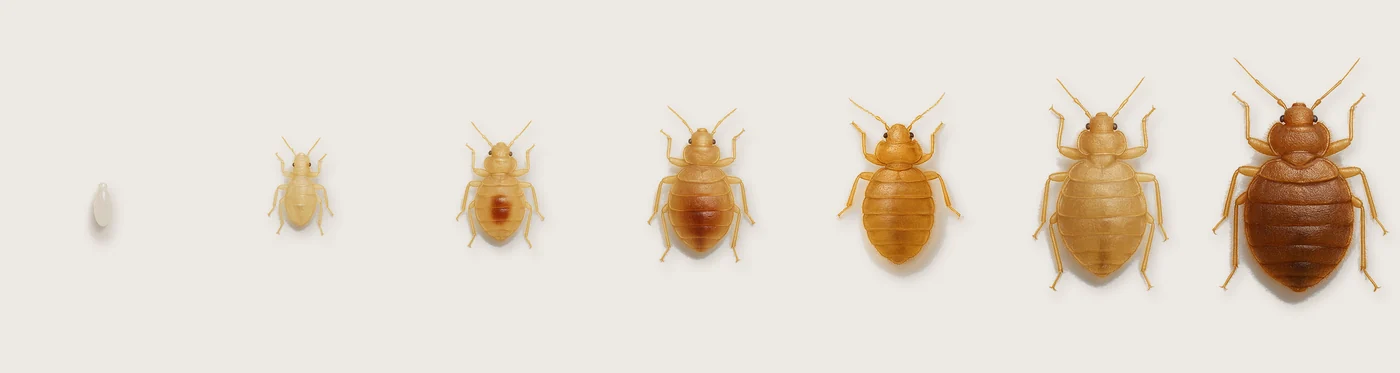
- Eggabout 1 mm, pearly white
- 1st nymphabout 1.5 mm
- 2nd nymphabout 2 mm
- 3rd nymphabout 2.5 mm
- 4th nymphabout 3 mm
- 5th nymphabout 4.5 mm
- Adultabout 5 to 7 mm
Why bed bugs come back
01Can bed bugs come back after a heat treatment?+
They can, if bed bugs are brought back in from outside the treated space. Heat treats everything inside the treated area on treatment day, including eggs. It cannot treat a car, a bag or a pair of shoes that was somewhere else. That is why we talk through every way bed bugs could return before we start.
02Why don’t you guarantee bed bug heat treatment?+
Because reintroduction is outside anyone’s control. In one real case, a family followed every step, but patio chairs and shoes left outside the treated area were carrying bed bugs and came back in. Any company that promises a guarantee is promising something heat cannot control. We would rather be honest with you.
03What if I do not treat my car?+
In one real case, a customer chose to treat the home but not the car. The home treatment worked, but bed bugs living in the car rode back inside and the home was reinfested. If your car may have bed bugs, include it in the plan.
04Can bed bugs travel on a person?+
Yes. In one real case, a bed bug was crawling on a customer’s arm while she signed her service paperwork. In another, a child arrived at a hospital with bed bugs in his shoes, and staff had to change him into fresh clothes. Bed bugs ride on people, shoes and clothing, so everyone in the household matters.
Signs of an infestation
01What are the most common signs of a bed bug infestation?+
The most common signs are small dark fecal spots, shed skins, tiny bloodstains on sheets, and the insects or their eggs in hiding spots. You might notice clusters of rust or ink-colored dots along mattress seams, pale shed casings, or smeared blood marks on bedding. Because bed bugs hide during the day, these traces are often easier to find than the insects themselves.
02What does bed bug fecal spotting look like?+
Bed bug fecal spotting looks like small, dark brown or black dots, similar to marks from a felt-tip pen, often found in clusters. Because the droppings are digested blood, they can smear or bleed slightly into fabric when wiped with a damp cloth. Common places to find them include mattress seams, box springs, sheets, and the walls or wood near where bed bugs hide.
03What are bed bug shed skins and casings?+
Shed skins, or casings, are the pale, empty outer shells bed bugs leave behind as nymphs molt and grow. Because a bed bug molts five times before adulthood, finding these translucent, bug-shaped husks is a strong sign of an active, breeding population. They often collect in the same protected cracks and seams where the bugs hide.
04Do bed bugs have a smell?+
Heavier bed bug infestations can produce a musty, sweetish odor that some people describe as similar to a damp or coriander-like smell. This odor comes from scent glands and is usually only noticeable when many bugs are present. Smell alone is not a reliable indicator, so it should be confirmed with visible physical signs.
05Where do bed bugs hide?+
Bed bugs hide close to where people sleep or rest, favoring tight, dark cracks and seams. Common spots include mattress and box spring seams, bed frames and headboards, baseboards, furniture joints, nightstands, behind wall outlets and switch plates, along carpet edges, and inside luggage. As a population grows, they spread farther from the bed into surrounding furniture and wall voids, which is why thorough inspection matters.
How heat treatment works
01How does bed bug heat treatment work?+
Heat treatment, also called thermal remediation, raises a room or home to 130 to 150°F, a temperature bed bugs cannot survive, and holds it long enough to reach every hiding place. Commercial heaters warm the space, air movers push the heat into furniture, cracks and wall voids, and technicians check temperatures by hand with heat guns every 15 to 20 minutes, so adults, nymphs and eggs are treated together.
02What temperature kills bed bugs?+
Bed bugs and their eggs cannot survive sustained high heat. Our treatments bring the space up to 130 to 150°F and hold it there long enough for the heat to soak into mattresses, furniture and wall voids, not just the air. Technicians check temperatures by hand with heat guns (infrared thermometers) every 15 to 20 minutes, including in the hardest-to-heat spots, so the whole space gets there.
03Does heat treatment kill bed bug eggs?+
Yes. Sustained heat at lethal temperatures kills bed bug eggs along with nymphs and adults, which is a key advantage of thermal remediation. Bed bug eggs are notoriously resistant to many treatments, so a method that reliably reaches and kills eggs helps break the reproductive cycle. Ensuring heat penetrates the protected spots where eggs are laid is essential to this result.
04Why can heat reach places sprays cannot?+
Heat treatment works by filling a space with lethal-temperature air that spreads into cracks, voids, and the inside of furniture, rather than relying on contact with a treated surface. Because warm air moves everywhere the space connects to, it can reach deep seams, wall voids, and gaps that are difficult to treat spot by spot. This whole-space approach is a core reason heat can address hidden bed bugs across a room.
05Can bed bugs become resistant to heat?+
No. Bed bugs cannot develop resistance to heat the way insects can build tolerance to some chemicals, because lethal heat physically overwhelms the biology of every life stage. Resistance is a genetic adaptation to a chemical's mode of action, and heat has no such mode to adapt around. This is one reason heat remains effective regardless of a population's chemical history.
06How is heat treatment different from chemical methods?+
Heat treatment kills bed bugs by raising the whole space to a lethal temperature, while chemical methods rely on applying products that bugs must contact or absorb. Heat leaves no chemical residue, penetrates hidden voids as warm air spreads, and kills eggs and adults in the treated area during a single sustained session. Chemical approaches often require repeat visits, may miss eggs, and can be limited where bed bugs have developed resistance. Bedbug Seekers uses heat only and does not apply chemicals.
07Does heat treatment leave any chemical residue?+
No. Heat treatment uses temperature alone to kill bed bugs, so it leaves no pesticide residue on surfaces, bedding, or belongings. This makes it a chemical-free option that many people prefer for bedrooms, kitchens, and homes with children, pets, or sensitivities. After the space cools, treated rooms can generally be used normally.
08Does heat treatment work in one visit?+
Heat treatment is designed to address all bed bug life stages in the treated area during a single sustained session, but "one visit" depends on the situation and does not guarantee that reintroduction can never happen. A thorough treatment that reaches lethal temperatures throughout the space can kill the bugs and eggs present that day. Preventing a new infestation afterward still depends on identifying the source and following good prevention habits. We never promise permanent eradication, because bed bugs can always be carried back in.
Treatment day & after
01How long does a heat treatment take?+
Most treatments are completed in one day. Setup, heating, holding the lethal temperature and cooldown together commonly take several hours. The exact time depends on the size and layout of the property, how heavily it is furnished and how severe the infestation is. You get a clearer estimate once we understand your space.
02Do I need to leave during treatment, and when is it safe to return?+
Yes, people and pets must be out of the treated area during heat treatment, and you return only after the space has cooled and your technician confirms it is safe. Because rooms are raised to high temperatures, occupancy during treatment is not safe. Your provider will tell you when re-entry is appropriate for your specific treatment.
03What happens to my belongings during heat treatment?+
Most household belongings stay in place during heat treatment so the heat can penetrate and kill bed bugs hiding inside them, which is part of why the method is effective. A few items that could be damaged by high heat are set aside beforehand, and we tell you which ones when you book, while furniture, bedding, and clothing generally remain so they are treated too. Technicians often reposition items to help warm air circulate around and through them.
04How much does bed bug heat treatment cost?+
The cost of bed bug heat treatment depends on the size and layout of the property, the severity of the infestation, and whether it is a home, apartment, or commercial space, so there is no single flat price. Because these factors vary so much, the honest answer is that pricing is tailored to your situation. To get a straight answer for your space, request a quote or call (866) 551-6552.
Prevention
01How can I avoid bringing bed bugs home from a hotel?+
Inspect the room before settling in and keep luggage off the bed and floor to reduce the chance of bringing bed bugs home. Check mattress seams, the headboard, and nearby furniture for fecal spots, shed skins, or live bugs, and use a luggage rack away from the wall. When you get home, unpack carefully and consider laundering travel clothing on hot settings.
02Is used furniture a bed bug risk?+
Yes, secondhand furniture, especially beds, couches, and upholstered pieces, is a common way bed bugs enter a home. Inspect used items closely along seams, joints, and undersides for live bugs, eggs, fecal spots, and shed skins before bringing them inside. When possible, avoid picking up discarded furniture left at the curb, since it may have been thrown out because of an infestation.
03Do mattress encasements help with bed bugs?+
Yes, a quality bed bug-proof mattress and box spring encasement can help by trapping any bugs inside and removing hiding spots along seams, making monitoring easier. Encasements do not kill an active infestation on their own, but they are a useful part of prevention and post-treatment monitoring. Leave them on for an extended period, since bed bugs can survive a long time without feeding.
04Does laundering kill bed bugs?+
Yes, washing and especially drying items on a hot cycle can kill bed bugs and eggs on clothing, bedding, and other launderable fabrics. The high heat of a dryer is the most reliable part, so running items through a hot dryer cycle is effective even for things that were only washed in cold water. Bag laundered items separately to avoid recontamination while you address the rest of the home.
05What should I do after a heat treatment to keep bed bugs from coming back?+
After treatment, monitor the area, reduce clutter, use mattress encasements, and be careful about what you bring into the home to lower the chance of reintroduction. Watch for any new signs over the following weeks and address the likely source, since bed bugs can be carried back in from travel, guests, or used items. Good ongoing habits are what keep a treated space bug-free over time.
California renters
01In California, who is responsible for bed bugs in a rental?+
In California, landlords are generally responsible for maintaining habitable rental housing, which typically includes addressing pest infestations like bed bugs. Tenants are usually expected to cooperate with inspection and treatment and to report problems promptly. Because rules and responsibilities can be detailed and change over time, verify current requirements and consult a local tenant resource or attorney for your specific situation.
02What are a California landlord's disclosure duties for bed bugs?+
California law generally includes bed bug disclosure and notification obligations for landlords, such as providing information to tenants and not knowingly renting a unit with a known infestation. The specifics of what must be disclosed and when can be detailed, so this is a general summary rather than legal advice. For current requirements, verify the law directly or speak with a local tenant resource or attorney.
03What should I do as a renter if I find bed bugs?+
Report the problem to your landlord or property manager in writing as soon as possible, and keep a dated record of your communications and any evidence. Documenting what you find with notes and photos helps establish a timeline and supports getting the issue addressed. Because tenant rights and procedures vary and can change, consult a local tenant resource or attorney if you need guidance on your specific situation.